
In industrial facilities, flammable gases, vapours, mists and combustible dusts may combine with air under certain conditions and form an explosive atmosphere. Such environments may occur not only in the oil, natural gas and chemical industries, but also in paint manufacturing, food, pharmaceuticals, plastics, woodworking, grain storage and many other sectors.
Safe management of explosive atmospheres requires more than simply using explosion-protected equipment. First, it is necessary to determine where, how often and for how long an explosive atmosphere may occur; then the equipment to be used must be selected according to the characteristics of the hazardous area.
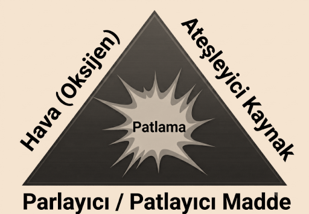
In general, three elements must be present at the same time for an explosion to occur:
Eliminating any one of these three elements, or keeping it within safe limits, is one of the fundamental approaches to reducing explosion risk.
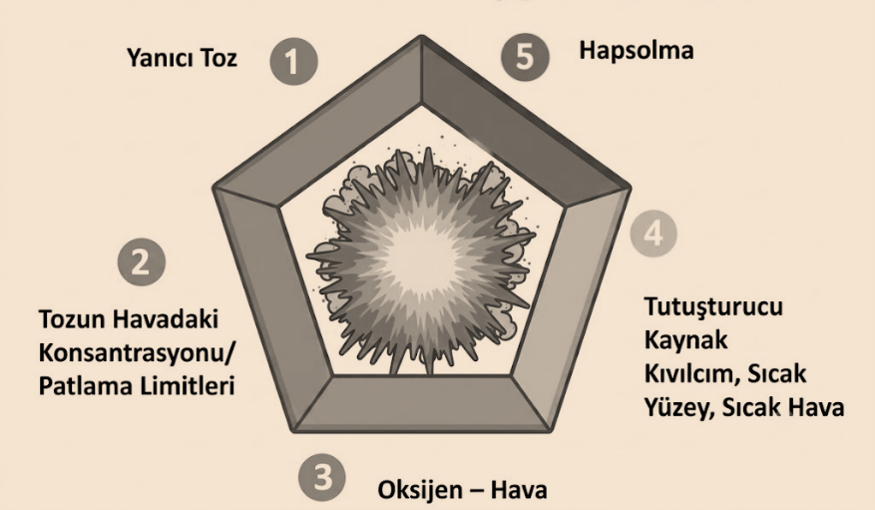
Flammable gases and vapours cannot explode at every concentration. For an explosion to occur, the concentration of the flammable substance in air must be within certain limits.
LEL (Lower Explosive Limit) refers to the lowest concentration of a flammable gas or vapour in air at which an explosion can occur.
UEL (Upper Explosive Limit) refers to the highest concentration at which an explosion can occur.
Below the LEL, the mixture is too lean in flammable substance; above the UEL, it is too rich. However, plant safety should not rely solely on these limits. Process conditions, ventilation, leakage potential and fault conditions must also be evaluated together.
Hazardous areas are divided into three main zones according to the frequency and duration of the occurrence of an explosive gas atmosphere:
Zone 0: An area in which an explosive gas atmosphere is present continuously, for long periods or frequently.
Zone 1: An area in which an explosive gas atmosphere is likely to occur occasionally during normal operation.
Zone 2: An area in which an explosive gas atmosphere is not likely to occur during normal operation, but if it does occur, it will persist only for a short period.
Hazardous area classification for facilities containing gases and vapours is carried out in accordance with EN IEC 60079-10-1.
Fine particles of many products such as flour, sugar, starch, coal, metals and plastics can form an explosive dust atmosphere under suitable conditions.
Zone 20: An area in which an explosive dust cloud is present continuously, for long periods or frequently.
Zone 21: An area in which an explosive dust cloud is likely to occur occasionally during normal operation.
Zone 22: An area in which an explosive dust atmosphere is not likely to occur during normal operation, but if it does occur, it will persist only for a short period.
Classification of combustible dust atmospheres is carried out in accordance with EN IEC 60079-10-2.
In hazardous areas, electrical equipment is not the only possible source of ignition. The following sources must also be considered in the risk assessment:
Therefore, explosion protection should not be assessed solely from the perspective of electrical installations; the process and all equipment used must be evaluated together.
Explosion protection measures are generally considered at three levels:
Where possible, the formation of an explosive atmosphere can be prevented by reducing the use of flammable substances, using closed systems, ensuring adequate ventilation or applying inert gas systems.
Where the formation of an explosive atmosphere cannot be completely prevented, suitable Ex equipment must be used. It is not sufficient for equipment to be simply described as “Ex-proof”. The equipment must be suitable for:
In processes where the possibility of an explosion cannot be completely eliminated, explosion venting systems, explosion suppression systems, isolation devices, flame arresters or structural protection measures may be applied.
The suitability of equipment for use in an explosive atmosphere cannot be determined solely by checking whether the equipment is certified.
Example ATEX / Ex marking:
II 2G Ex db IIB T4 Gb
Such a marking provides important information about the equipment's intended area of use, type of protection, gas group, temperature class and equipment protection level. The marking must be evaluated together with the hazardous area classification of the installation.
Incorrect equipment selection may create a serious ignition risk for the facility, even when certified equipment is used.
Workplaces where explosive atmospheres may occur must systematically assess explosion-related risks. An Explosion Protection Document (EPD) should generally address:
In Türkiye, these requirements are addressed under the Regulation on the Protection of Employees from the Hazards of Explosive Atmospheres.
Safety in explosive atmospheres is not limited to the use of Ex-protected equipment. A safe installation requires the correct identification of areas where explosive atmospheres may occur, proper Zone classification, assessment of ignition sources, and selection of equipment in accordance with ATEX requirements.
Proper hazardous area classification, explosion risk assessment, equipment suitability assessment and Explosion Protection Document preparation are essential for protecting employees and ensuring the safe and sustainable operation of industrial facilities.